后赤壁赋 A Second Drink in the River Moon at Red Cliff
Updated: May 4
A Second Drink in the River Moon at Red Cliff
--A prose poem
Chinese original: Su Shi (11th AC, social name 'Zizhan', art name 'Dongpo')
English version: Julia Min (May 2024)
It was the third full moon since our last drink on the river. On my way home to Linggao after my day’s work at Snow Hall, I ran into two friends heading home via Muddy Slope. The October frost had stripped the trees bare, and the ground was covered with fallen leaves. Then the shadow began to take form. In the serene blue realm above, a fair moon smiled down upon us, sending gentle vibes throughout the night. Soon we found ourselves humming the same hymn in praise of the radiant beauty.
The slope seemed too short a walk. I sighed, “How often do we see such a breezy night with a beaming moon in a cloudless sky? Let’s not waste such a generous offer from Nature. But how can we celebrate without food and wine?”
One friend opened his fish basket: “My day’s fishing has rewarded me with one fish at sunset. It has a big mouth and tiny scales like the River Song sculpin. Can you find some wine?”
I hurried home, hoping my wife might have something. To my joy, she said, “You don’t know how lucky you will be! I have long saved about 2 litres to meet your urgent needs.”
So here we were, with fish and wine, heading again towards the boat by Red Cliff.
Only three months since our last visit, about the same time, same place, and same people on the same boat, yet we were greeted by a very different world. The river gurgled, splashing and splooshing against the cliff, a steep wall hundreds of metres high. The water level had now receded greatly, revealing many more rocks along the bank. The distant hills and mountains appeared higher, with the moon seeming smaller over a skyline clearer and broader.
The tides pushed our boat towards the cliff. I ventured ashore for a climb, holding the corners of my robe to find footholds. Often, I had to hang onto vines and branches like a monkey to make my way through the bushes amid savage rocks. As I approached the raptors’ cliff nests – an uncharted territory never before visited by humans -- I had a bird’s-eye view of the Yangtze River at what is called the Palace of Fengyi, home of the water god.
My two friends stayed safe on the boat, scared of the steep climb. The river's surface began to roll with white waves as the gusty wind grew, sending a chill down my spine. Again, I was by myself, completely off the beaten track. With a loud whistle, I found myself trembling in the surrounding bushes, followed by a long echo rippling through the valley. It was a breathless moment filled with fear and a nameless sadness. I realised the journey had to end halfway. So I went down to the boat and joined my mates.
Together to the centre of the river we rowed, and let the little boat drift freely with the flow.
Just as midnight was approaching, a shriek from some large bird pierced the serene world across the river. It was a crane, giant and lonely—with white wings the size of a wheel and a solid black tail like a Daoist's robe—who announced himself by flying past us, just missing the gunwale. Before long, we all went back home, settled and safe.
Then, in a dream, a Daoist visited me. After a courteous bow, he asked me with a gentle smile: “Was it an enjoyable night at the Red Cliff?”
I was curious and wished to know his name, but he lowered his head and silent he remained. “Oh my, my goodness! It was you last night, was it? You made a loud call and flew past our boat from east to west.”
The Daoist only smiled back at me as he disappeared into the mist. Startled awake, I rushed out of the Lingao residence. There was no one in sight, just a vacant world, a void night…
后赤壁赋
原作: 苏轼(字子瞻, 号东坡居士; 11世纪北宋)
英译及赏析: 闵晓红(2024.06)

是岁十月之望,步自雪堂,将归于临皋。二客从予,过黄泥之坂。霜露既降,木叶尽脱。人影在地,仰见明月,顾而乐之,行歌相答。已而叹曰:“有客无酒,有酒无肴,月白风清,如此良夜何?”客曰:“今者薄暮,举网得鱼,巨口细鳞,状似松江之鲈。顾安所得酒乎?”归而谋诸妇。妇曰:“我有斗酒,藏之久矣,以待子不时之须。”于是携酒与鱼,复游于赤壁之下。
江流有声,断岸千尺。山高月小,水落石出。曾日月之几何,而江山不可复识矣。予乃摄衣而上,履巉岩,披蒙茸,踞虎豹,登虬龙,攀栖鹘之危巢,俯冯夷之幽宫,盖二客不能从焉。划然长啸,草木震动;山鸣谷应,风起水涌。予亦悄然而悲,肃然而恐,凛乎其不可留也。反而登舟,放乎中流,听其所止而休焉。
时夜将半,四顾寂寥。适有孤鹤,横江东来,翅如车轮,玄裳缟衣,戛然长鸣,掠予舟而西也。须臾客去,予亦就睡。梦一道士,羽衣蹁跹,过临皋之下,揖予而言曰:“赤壁之游乐乎?”问其姓名,俯而不答。呜呼噫嘻!我知之矣。畴昔之夜,飞鸣而过我者,非子也耶?道士顾笑,予亦惊寤。开户视之,不见其处。
Notes:
1. Snow Hall: the residence Su Shi built in Huangzhou during his exile, named after a snow painting on its walls.
2. Linggao: Su Shi's temporary dwelling near the Yangtze River, where he lived before Snow Hall was built.
3. River Song sculpin: a famous fish from the Song River, celebrated in Chinese literature as a delicacy.
4. Palace of Fengyi: the mythical palace of Fengyi, the god of the Yangtze River in Chinese folklore.
5. The crane's black-and-white plumage: Its colouration mirrors the traditional attire of a Daoist priest—a black mantle over a white robe. This prepares the reader for the crane's transformation into a Daoist in Su Shi's dream.
Appreciation:
This prose poem serves as a companion to the previous one, sharing a similar background and continuing the thematic progression. Together, they have been celebrated as pioneering works of a new era, marking a new category — prose poetry — distinct from any previously written prose. Well, this is but one small brainchild among the many outstanding creations Su Shi produced during his dramatic lifetime…
As the sister piece, this one would be expected to present some big philosophical ideas about the world, as in the first one. Some readers might feel somewhat disappointed after the first reading, as if it were an unfinished work, because no evocative point seems to have been made. Hence, contemporary critics favour the first one. But in the Song dynasty, this second piece was more embraced for its simplicity and symbolic resonance, because the ‘a vacant world, a void night’ evokes a larger, more boundless imagination compared with the ‘physical’ world we see. Like many paintings of the dynasty, it favoured a minimal use of paint, colours, and subjects to evoke diverse reactions in readers’ minds. Or you may say that artistic value arises from the collaboration between the artist and readers' creative minds. The more void left there, the more space for the imagination, the more adaptable and longer the value of the artistic work.
This second moon-night drink with friends can be divided into three parts. The first part serves as a prelude, ushering readers back to the first boat drink, with a brief mention of his second wife, who had shared his hardships and understood his needs. The second part focuses on their experience aboard, ashore, and aboard – an implication of the ups and downs in his life: from a high official in the Royal Court to a common folk struggling for survival in the fields, and his quiet wish to be called back. It was early winter, a much drier season, when he could have a clearer view beyond – a reflection of his spiritual progress in his world outlook. The obstacles that had looked fearful had now become a minor issue before a stronger mind. The moon was small compared with mighty mountain ranges; the hidden stones in rocky waters were revealed when the water level changed — referring to the literary crime, a sheer setup by his opponents.
Unexpectedly, the theme shifts from seasonal observation of nature to myth and theology, then to the celestial realm. It clearly indicates his persistent spiritual pursuit of a liberated, secluded lifestyle free of all worldly attachments. Well, we all know Dongpo loved the world so much that he would never, in reality, become a Daoist. It was just a thought, like a rippling stream in his mind, comforting and nourishing, but not a replacement. The shift from the real to the void, from humans to celestials, offers readers a more dynamic experience. It can also be seen as a duality that runs through many minds: seemingly conflicting, yet in need of each other like yin and yang, ultimately for balance and harmony in one’s life.
Reference:
1. baike.baidu.com;
2. 《熊逸说苏轼.30讲》;
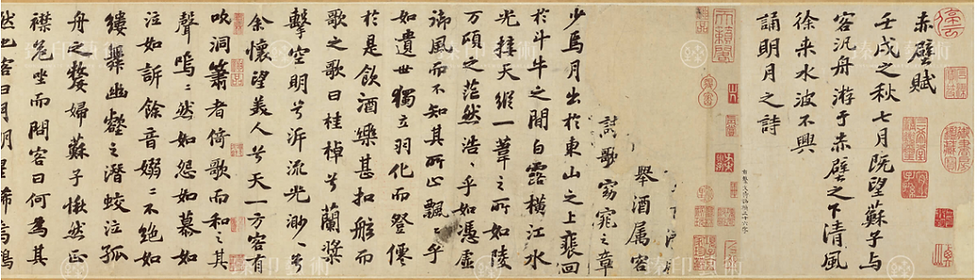
3. picture from “头条--墨语江湖;


Comments