洞仙歌·冰肌玉骨 Pure as Snow Her Complexion
Updated: May 9
Pure as Snow Her Complexion
Chinese original: Su Shi (11th AC, social name 'Zizhan', art name 'Dongpo')
English translation & annotation: Julia Min (July. 2024)
(There was an old nun in my hometown, Meizhou. I’m not sure of her first name, but I’m pretty sure her family name was Zhu. I was about seven, and she was in her nineties. I remember she was quite proud to tell us that she had often accompanied her master on visits to the palace of King Meng Chang, the ruler of Shu State. She was also quite impressed by a ci poem composed by the King when he and his Consort Flora were enjoying a cool night by Mohe Pool on a hot summer evening. She could literally remember every line. But the poem can’t be retrieved now, as forty years have passed and she must be long dead. I can only remember the first two lines, and I often linger on the rhymes and the vibe of the tune. As it happened, the tune “The Celestial from the Cave” came to mind. So here it is, an effort towards a possible complete version.)
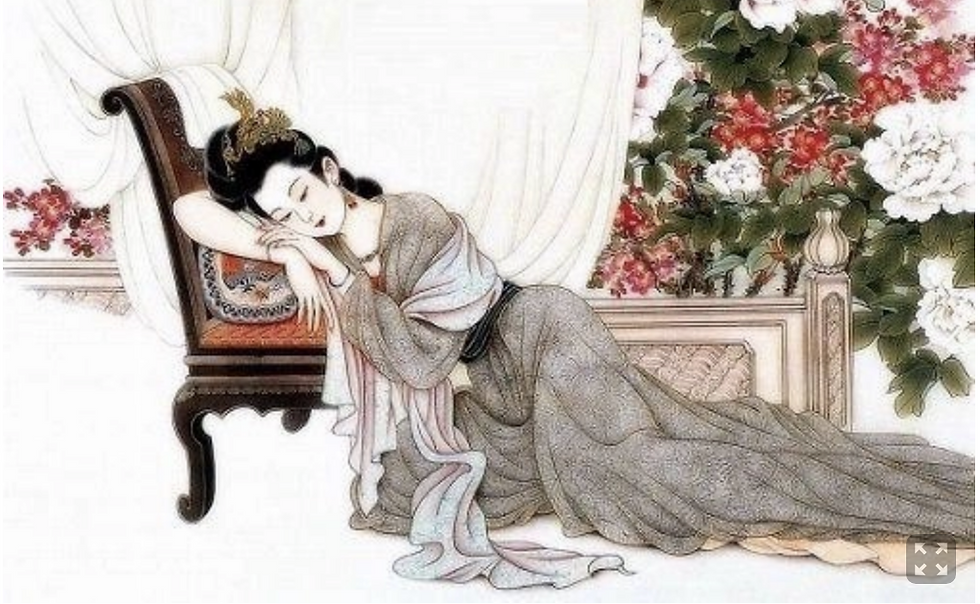
Pure as snow, her complexion,
the grace of jade from within.
Infused in the gentle breeze, a subtle scent
sneaks from her bath pool of blossoms.
Naughty is the wind that opens for the moon
her embroidered curtains for a quick glimpse.
There she is, leaning on a soft cushion,
her eyes vacant, her long hair loosened.
Gently, she raises herself,
her fair hand in mine, stepping to the garden.
The stars drift in the Milky River, twinkling,
as Alioth of the Dipper is about to descend.
She asks for the time, and I reply:
“My darling, it has now passed midnight.”
From brimming to dimming, the Moon turns.
She figures with her fingers, sighing:
“It’s drawing nearer, the falling season.
Another year of gold will soon be stolen.”
Notes:
1. Shu State: a state conquered by the Great Song ( Northern Song Dynasty).
2. Meng Chang(孟昶): Shu State’s last king, in reign from 934 to 964 AC, who died 7 days after 被那个kept under house arrest in Bianliang (Kaifeng today), the capital of Northern Song. He’s well known for his talent in art, including his ci poems.
3. Consort Flora(花蕊夫人): the most favoured consort of Meng Chang, well-known for her beauty and her poems. Legend has it that the Song Emperor was impressed by her beauty and poetic talent, and he kept her in the palace as his consort.
4. Mohe Pool: the historical site can still be traced today in Zhaojue Temple in Chengdu City. The word Mohe (摩诃) originated in Buddhist scripture and means "wisdom."
Appreciation:
Based on the prelude, we can infer that Dongpo was about 47 years old when he wrote this poem, so the year could be around 1983/84, the last year of his banishment in Huangzhou (in today’s Hubei Province).
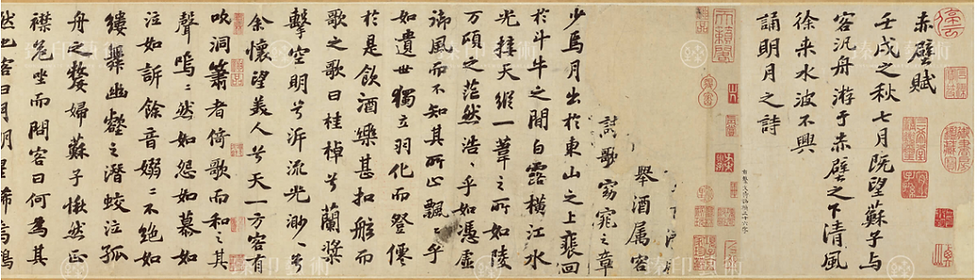
This is another example of Su Shi’s sentimental poems, romantic and sophisticated in their vibes, though outshone by his heroic poems. The rhyming wave flows from the beauty’s secret bath pool of fresh flowers to her chamber, then to the garden in the company of her lover, the king, and extends to the Starry River, hinting that the happy night is about to end. The theme is explored further through the seasons and the year, deepening the sentiment that nothing gold can stay. It’s a sigh from the beauty, but also a sigh from Dongpo, who strongly felt his prime years were wasted there at Huangzhou and that his ambition was as if gone with the west wind. Such was the tune of his writings during his five-year banishment, full of regrets yet still wishing to be pardoned and summoned back to the Court, as you can find in his “Meditating on the Past at Red Cliff” and his prose poems on his boat drinks at Red Cliff(前后赤壁赋).
It is, in fact, a universal sigh in the human world about mortality, about the helplessness of holding a good moment. Nature could be defined as ‘cruel’ in human understanding. Robert Frost’s poem came to my mind again— “Nothing Gold Can Stay”.
洞仙歌·冰肌玉骨
原作: 苏轼(字子瞻, 号东坡居士; 11世纪北宋)
英译及赏析: 闵晓红(2024.07)
(仆七岁时,见眉州老尼,姓朱,忘其名,年九十岁。自言尝随其师入蜀主孟昶[chǎng]宫中,一日大热,蜀主与花蕊夫人夜纳凉摩诃[hē]池上,作一词,朱具能记之。今四十年,朱已死久矣,人无知此词者,但记其首两句,暇日寻味,岂《洞仙歌》令乎?乃为足之云. )
冰肌玉骨,自清凉无汗。
水殿风来暗香满。
绣帘开,一点明月窥人,
人未寝,倚枕钗横鬓乱。
起来携素手,庭户无声,
时见疏星渡河汉。
试问夜如何?夜已三更。
金波淡,玉绳低转。
但屈指西风几时来?
又不道流年暗中偷换。
Reference:
1. baike.baidu.com;

Comments